
Why Join Fitness Challenges: Motivation and Community

Starting a new fitness routine can feel daunting when every option seems overwhelming or confusing. For many across the UK, fitness challenges are becoming the go-to way to add structure, motivation, and camaraderie to their health journey. By focusing on community-driven, measurable fitness challenges—not random, exhausting workouts—you create lasting habits that fit your real life and goals, with added support to keep you going when motivation dips.
Table of Contents
- Fitness Challenges Defined And Misconceptions
- Types Of Fitness Challenges In The UK
- Community, Motivation And Accountability Benefits
- How Challenges Enhance Progress And Results
- Risks, Limitations And How To Avoid Them
Key Takeaways
Understanding Fitness Challenges Fitness challenges are structured programmes designed to gradually increase physical activity and improve specific fitness outcomes over time. Community and Accountability Participating in fitness challenges creates a supportive environment that enhances motivation and commitment, making it easier to achieve goals. Realistic Progression Structured challenges focus on measurable milestones, ensuring participants see results within a realistic timeframe, typically within 6 to 8 weeks. Safety and Smart Progression Proper guidance and gradual progression are crucial to avoid injuries and ensure long-term success in fitness challenges.Fitness Challenges Defined and Misconceptions
Fitness challenges are structured programmes designed to increase your physical activity and improve measurable fitness outcomes over a set period. They’re not just random workouts—they combine clear goals, tracking mechanisms, and social accountability to keep you motivated.
The World Health Organisation defines physical activity as movement produced by skeletal muscles that requires energy expenditure. This covers everything from your daily commute to formal gym sessions. Here’s where confusion often creeps in.
What Fitness Challenges Actually Are
Fitness challenges are purposefully structured initiatives that transform general physical activity into measurable, progressive programmes. They typically include:
- Clear start and end dates (usually 4 to 12 weeks)
- Defined objectives you can track (strength gains, distance covered, body composition changes)
- Progressive difficulty that adapts as you improve
- Community elements for accountability and support
- Regular progress monitoring and feedback
These aren’t one-size-fits-all affairs. Modern challenges accommodate different fitness levels, from complete beginners to advanced athletes, making them accessible to anyone willing to commit.
Common Misconceptions Holding You Back
Misunderstanding what fitness challenges entail stops many people from joining. Let’s clear these up.
Misconception 1: Fitness challenges require extreme intensity. You don’t need to exhaust yourself daily to see results. Fitness challenges emphasise achievable, progressive goals designed for different fitness levels, not just elite athletes pushing maximum effort.
Misconception 2: They’re just fancy fads. Fitness challenges have evolved from passing trends into sustained, structured programmes. The 2023 global fitness survey confirms they’re now mainstream approaches backed by evidence of measurable progress.
Misconception 3: You must do the same workout as everyone else. Most quality challenges offer variations. Whether you prefer strength training, bodyweight exercises, functional fitness, or group programmes, you’ll find options matching your preferences.
Misconception 4: Results take months to appear. Many participants see changes within 2 to 4 weeks—improved energy levels, better sleep, or increased strength—before dramatic physical transformations.
Why This Distinction Matters
Understanding what a fitness challenge genuinely is helps you set realistic expectations and choose the right one for your situation. You’re not signing up for torture; you’re committing to a structured system with built-in support.
Fitness challenges bridge the gap between knowing what to do and actually doing it consistently. Structure plus community equals results.
Pro tip: Before joining any fitness challenge, confirm it offers progression options and community support—these two elements separate effective challenges from gimmicks that fade after week two.
Types of Fitness Challenges in the UK
The UK fitness landscape offers diverse challenge formats to suit different preferences, schedules, and goals. Whether you prefer working solo or within a group, online or in-person, there’s a structured programme designed for you.
Community-Based Group Challenges
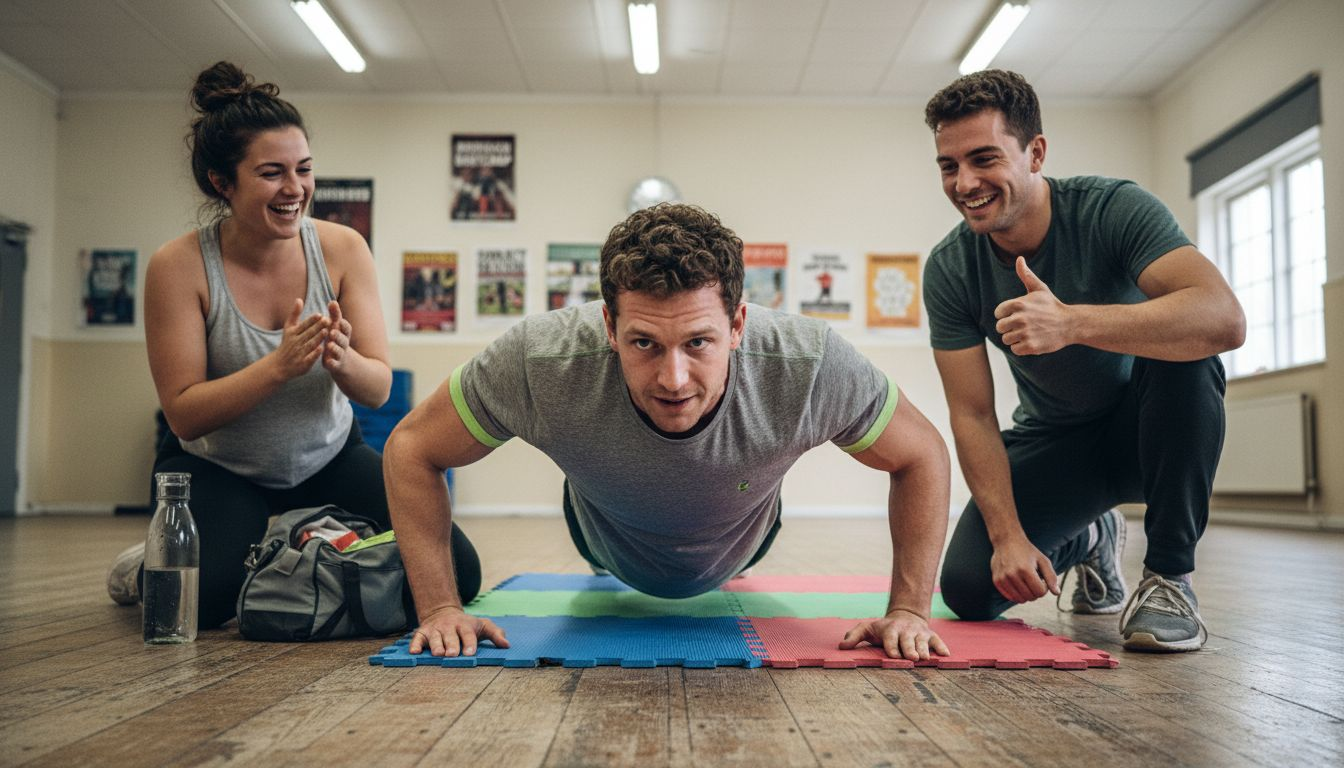
Group fitness classes remain one of the most popular challenge formats across the UK. These bring together multiple participants in a shared space, creating immediate accountability and motivation through shared experience.
Common group challenge types include:
- Weekly circuit training competitions
- Running clubs with structured training plans
- Dance or aerobics-based group challenges
- Team sports leagues and tournaments
- Workplace wellness challenges involving multiple employees
Group challenges work particularly well when you thrive on social connection and friendly competition. The camaraderie pushes you harder than you’d push yourself alone.
Online and App-Based Challenges
Digital fitness challenges have exploded across the UK, offering flexibility for busy schedules. Fitness participation data shows growing engagement with online guided challenges that accommodate home-based training.
These typically feature:
- Video-guided workouts you complete at home
- Progress tracking through dedicated apps
- Virtual leaderboards and community forums
- Flexible scheduling around your routine
- Real-time feedback and form corrections
Online challenges suit people with unpredictable schedules, those caring for dependants, or anyone preferring privacy during their fitness journey.
Running and Endurance Events
Recreational running events form a significant chunk of UK fitness challenges. From 5K fun runs to marathon training programmes, these challenges span all ability levels.
Popular running challenge formats:
- Parkrun weekly community races
- Month-long distance accumulation challenges
- Couch-to-5K structured programmes
- Trail running competitions
- Virtual marathon challenges tracking weekly mileage
Running challenges appeal to those seeking measurable progression and the satisfaction of crossing finish lines.
Workplace Wellness Competitions
Corporate fitness challenges engage employees across organisations. These create accountability through team participation and often include workplace recognition or prizes.
They address genuine barriers: time constraints get managed through work-based sessions, and social connections strengthen alongside fitness improvements.
Here’s a summary comparing major types of fitness challenges available in the UK:
Group Classes Local gyms, studios Social motivation, friendly competition Strong, in-person support Online/App-Based Home, digital platforms Flexibility, privacy, busy schedules Virtual forums, leaderboards Running Events Parks, outdoor venues Progress tracking, endurance goals Regular, in-person meetups Corporate Programmes Workplaces Team goals, staff wellbeing Organisational, group supportThe most successful fitness challenges aren’t the flashiest—they’re the ones matching your lifestyle, preferences, and what actually keeps you showing up week after week.
Choosing Your Challenge Type
Your ideal challenge depends on three factors: your schedule flexibility, your social preference, and your primary motivation (strength, endurance, weight loss, or general health).
Someone juggling young children might thrive with online challenges offering 20-minute workouts, whilst a retired person might prefer the social richness of weekly group classes or running clubs.
Pro tip: Start by identifying whether you’re driven by social accountability or personal discipline, then select a challenge format matching that reality—mismatched formats lead to dropouts by week three.
Community, Motivation and Accountability Benefits
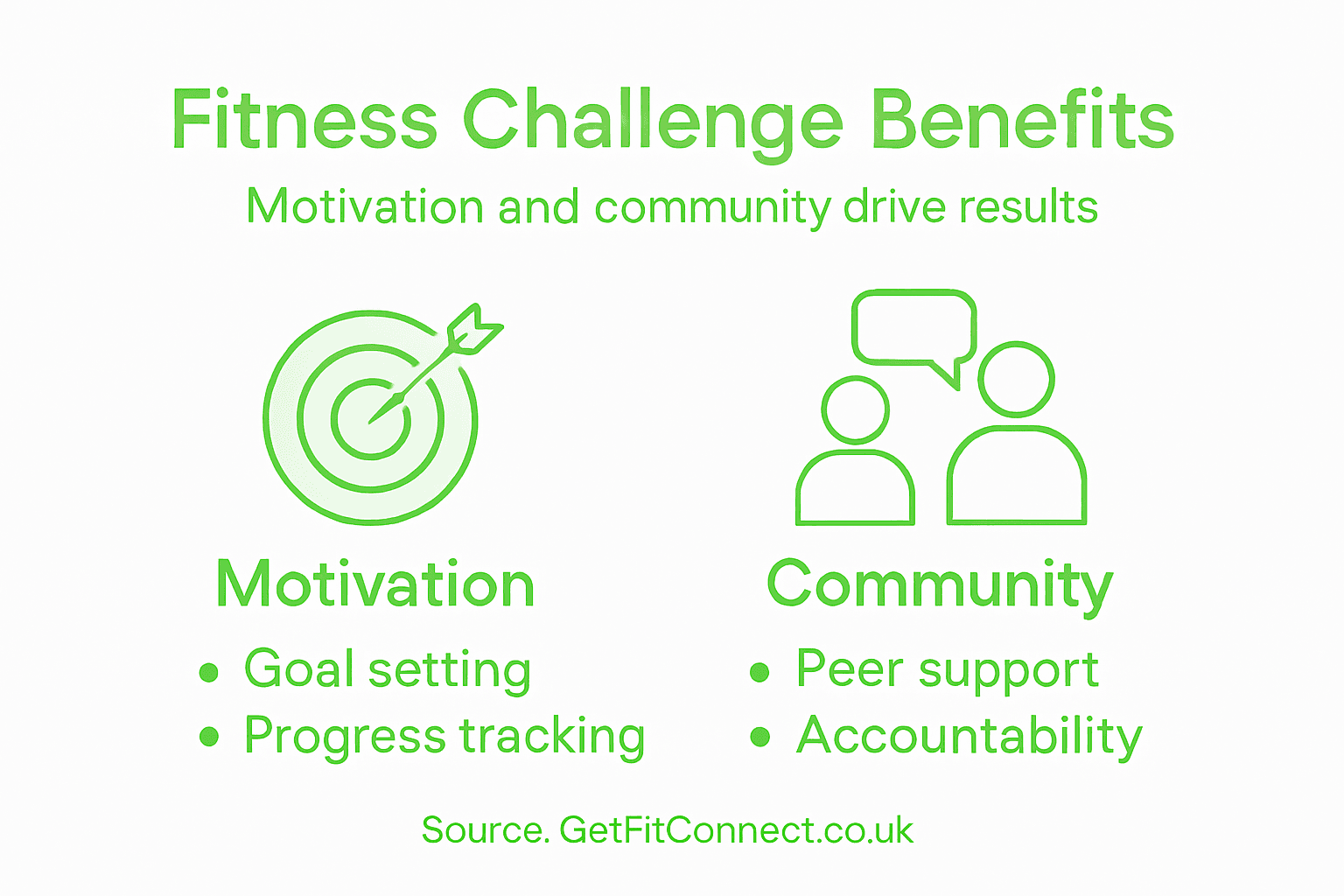
The real power of fitness challenges lies beyond the workout itself. When you join a community, motivation shifts from a constant struggle to something almost inevitable. The people around you become your invisible support system.
The Social Support Mechanism
Social context fundamentally changes how your body responds to exercise. Community participation and peer motivation reinforce physical activity behavior in ways individual willpower alone cannot match.
When others are counting on you—or you’re watching their progress—something shifts. You show up on cold mornings because your running club expects you. You push harder during circuits because your teammate is right beside you.
This isn’t coincidence. It’s neurobiology. Your brain releases more dopamine when exercising socially than alone, creating genuine pleasure rather than punishment.
Psychological and Mental Health Benefits
Fitness challenges deliver profound mental health gains beyond physical transformations. Participation in fitness challenges increases psychological well-being, self-esteem, and belonging.
Key mental health improvements include:
- Reduced anxiety and depression symptoms
- Increased confidence in other life areas
- Better sleep quality and stress management
- Sense of achievement and purpose
- Reduced feelings of isolation
You’re not just building muscle or endurance. You’re building resilience, self-belief, and genuine connection with others pursuing similar goals.
Accountability as Your Invisible Force
Accountability is the glue holding people to commitments. When you’ve publicly stated your goal, when teammates know you’re committed, when progress is visible—quitting becomes harder.
This works through multiple channels:
- Social norms: You don’t want to let others down
- Visible progress: Seeing your name on leaderboards motivates continued effort
- Regular check-ins: Weekly weigh-ins, fitness tests, or group meetings create natural review points
- Shared struggle: Everyone’s tired, everyone’s sore, but you’re all doing it together
Accountability transforms motivation from something you hunt for into something your environment automatically provides.
Building Real Connections
Fitness challenges create organic friendships based on shared effort and mutual support. These aren’t forced team-building exercises—they’re genuine relationships built through sweat and encouragement.
Long-term participants often report their challenge community becoming their actual social circle, meeting outside sessions for coffee or celebrations.
Accountability without community feels like surveillance. Community without accountability feels like a hobby. Together, they’re unstoppable.
Why This Matters for Your Success
Statistics show community-based fitness programmes have significantly higher completion rates than solo efforts. People stay committed longer, progress further, and maintain results more effectively.
You’re not relying on fleeting motivation. You’re tapping into proven psychological mechanisms that keep you moving forward even when motivation dips.
Pro tip: Choose a challenge with a tight-knit group rather than a massive programme—smaller communities create stronger accountability bonds and deeper friendships that sustain long-term commitment.
How Challenges Enhance Progress and Results
Structured fitness challenges work because they create conditions your body cannot ignore. Progressive overload, consistent stimulus, and measurable milestones combine to produce real physiological change. This is where theory meets tangible outcomes.
The Physiological Adaptation Mechanism
Your muscles only grow when consistently challenged beyond their current capacity. Structured fitness challenges improve muscle strength, power, and flexibility through systematic progressive stimulus.
Challenges force this progression because they demand it. Week one baseline becomes week four’s warm-up. You cannot stay stagnant within a properly designed framework.
This progression is non-negotiable. Your body adapts or the challenge becomes unmanageable—so adaptation happens.
Setting and Achieving Measurable Milestones
Challenges provide structured goal-setting frameworks breaking massive objectives into achievable steps. Instead of vague “get fit” aspirations, you work toward concrete targets: add 5 kilograms to your squat, run an extra kilometre, complete 50 push-ups consecutively.
Measurable milestones matter because they:
- Create psychological momentum through early wins
- Provide objective feedback on actual progress
- Enable course correction when needed
- Generate dopamine hits from achievement
- Build self-efficacy through proven competence
Your brain recognises real progress differently than imagined progress. Seeing numbers improve changes your identity from “trying” to “achieving.”
Enhanced Mental Toughness and Self-Regulation
Fitness challenges strengthen mental toughness and self-regulation, psychological traits that transfer across life domains.
When you complete a gruelling workout because you committed, your brain learns you keep promises—to yourself and others. This reinforces self-efficacy in other challenging situations.
The discipline required for fitness bleeds into work, relationships, and personal development. You become someone who follows through.
Consistency as the Hidden Weapon
Challenges force consistency in ways random gym visits never achieve. Eight weeks of structured training produces exponentially better results than eight months of sporadic effort.
Consistency creates:
- Sustainable habit formation (66 days minimum)
- Cumulative physiological adaptation
- Improved recovery and nutrition timing
- Momentum that carries beyond the challenge
- Trust in the process even during plateaus
Tracking Progress Visibility
Most challenges include progress tracking—apps, leaderboards, or check-in sheets. Seeing your own advancement visualised creates powerful motivation loops.
You’re not relying on how you feel. You’re watching data confirm progress objectively. This transforms frustrating plateaus into evidence of neural adaptation before physical change appears.
The difference between people who see results and those who don’t often isn’t effort—it’s measurement. What gets tracked gets improved.
Realistic Timelines for Real Change
Six to eight week challenges align with actual physiological adaptation windows. Strength gains appear within 3-4 weeks. Body composition shifts become visible by week 6-8. Mental clarity improvements happen almost immediately.
This realistic timeframe prevents the frustration destroying most fitness attempts. You’re not chasing impossible overnight transformation—you’re experiencing genuine, predictable progress.
To help visualise realistic fitness challenge timelines, here’s an overview of what participants often experience:
Week 1 Improved energy, slight soreness Increased optimism Excitement from starting Weeks 2-4 Strength gains, better sleep Reduced stress, confidence Motivation from progress Weeks 6-8 Visible body composition shifts Greater self-belief, resilience Sustained momentum, habit formedPro tip: Photograph and measure yourself on day one and keep written records—visual proof of progress matters more psychologically than scale weight alone, especially when muscle replaces fat.
Risks, Limitations and How to Avoid Them
Fitness challenges deliver genuine results, but they aren’t risk-free. Understanding potential dangers and knowing how to navigate them separates transformative experiences from painful setbacks. The good news? Most risks are entirely preventable with proper approach.
Common Injury Risks
Improper technique and rapid progression are the primary culprits. Fitness challenges carry injury risks including muscular damage and overtraining when participants push too hard without proper supervision or skill foundation.
You cannot will your way through poor form. Ego lifting—moving heavy weight with compromised technique—creates pain that persists long after the challenge ends.
Common injuries within challenges include:
- Lower back strains from deadlift variations
- Shoulder impingement from overhead pressing
- Knee ligament strain from jump-based movements
- Wrist injuries from plank progressions
- Muscular tears from excessive volume increases
These aren’t random. They follow predictable patterns when progression outpaces skill development.
Overtraining Syndrome
Overtraining happens when volume or intensity exceeds your recovery capacity. Week two enthusiasm often leads to week four burnout—mental and physical exhaustion destroying results.
Warning signs include:
- Declining performance despite consistent effort
- Persistent fatigue and poor sleep
- Elevated resting heart rate
- Frequent minor illnesses
- Loss of motivation or enthusiasm
Challenges can trigger overtraining because they’re designed to push you. Listen to your body when it’s genuinely fatigued versus when motivation temporarily dips.
Cardiac and Pre-existing Condition Risks
Physical activity involves risks including sudden cardiac events in susceptible individuals, though benefits outweigh risks when proper screening occurs.
If you have:
- Family history of heart disease
- Previous cardiac events
- Unmanaged hypertension
- Diabetes
- Chronic joint conditions
You need medical clearance before beginning intense challenges. This isn’t overcautious—it’s essential. Your doctor knows your specific risks.
Avoiding Injury Through Smart Progression
Progressive overload must respect your adaptation window. Increase weight, reps, or intensity by 5-10% weekly, never more. Your body adapts in weeks 2-4, so patience actually accelerates results.
Smart progression means:
- Mastering movement patterns before adding load
- Starting conservatively on unfamiliar exercises
- Incorporating adequate rest days (at least 2 weekly)
- Scaling movements to match current ability
- Stopping immediately when pain (not just discomfort) appears
Choosing Supervised Challenges
Coaching transforms risk profiles dramatically. Professional trainers spot form breakdowns, adjust progressions, and modify for individual limitations you might not recognise yourself.
When selecting a challenge, prioritise those offering professional feedback. Group challenges with qualified instructors provide accountability without the isolation of online-only programmes.
Benefits of fitness challenges vastly outweigh risks when you progress sensibly, maintain proper form, and respect your body’s signals. Rushing destroys both.
Pre-Challenge Medical Clearance
Before starting any structured challenge, especially high-intensity programmes, consult your GP—particularly if inactive previously or managing chronic conditions. This simple step prevents the small percentage of serious incidents.
Your doctor can flag specific modifications needed for your physiology, ensuring you participate safely.
Pro tip: Film yourself performing key movements and review the footage weekly—you’ll spot form deterioration before injury occurs, and video provides trainers objective reference for targeted feedback.
Unlock Your Fitness Potential with Community and Support
Struggling to stay motivated on your fitness journey or finding it hard to maintain accountability? The article highlights that fitness challenges succeed when they combine structured progression, social support, and measurable milestones. These are exactly the key elements many people need to break through barriers like inconsistency, lack of motivation, or feeling isolated in their efforts.
GetFitConnect.co.uk offers a digital ecosystem designed to solve these pain points. With personalised coaching from professional trainers, access to nutrition guidance, and an engaged community, you gain the accountability and camaraderie that turn short-term challenges into lifelong habits. Features like gamified challenges, progress tracking, and community forums help keep you motivated and connected every step of the way.
Join thousands of UK fitness enthusiasts now at GetFitConnect.co.uk to access expert coaching, personalised workout and meal plans, and unique community features made for real people with real goals. Embrace fitness challenges with confidence knowing you have structure, support, and the tools to succeed. Start your transformation today and make every workout count.
Frequently Asked Questions
What are fitness challenges?
Fitness challenges are structured programmes designed to increase physical activity and improve fitness outcomes over a set period, typically involving clear goals, tracking mechanisms, and community accountability.
How can fitness challenges improve my motivation?
Fitness challenges create a supportive community where participants hold each other accountable, making it easier to stay motivated. The positive social interactions and shared goals foster a sense of belonging and encouragement.
What types of fitness challenges are available?
There are various types of fitness challenges, including community-based group challenges, online/app-based challenges, running and endurance events, and workplace wellness competitions, each catering to different preferences and goals.
How do I choose the right fitness challenge for me?
Selecting the right fitness challenge depends on your schedule flexibility, social preferences, and primary fitness motivations. Consider whether you thrive in social settings or prefer online formats, and ensure the challenge aligns with your fitness interests.
Recommended
- Find Personal Trainers Near You | FitConnect UK
- FitConnect - Find Your Perfect Fitness Coach | Personal Training, Nutrition & Combat Sports
- FitConnect - Find Your Perfect Fitness Coach | Personal Training, Nutrition & Combat Sports
- How to Set Fitness Goals for Maximum Results – MyGymSupplements
- Why Join a Running Event – Health, Fun, and Community - MK Marathon Weekend, Milton Keynes 3-4 May 2026
Ready to Start Your Fitness Journey?
Connect with expert coaches who can help you achieve your goals.